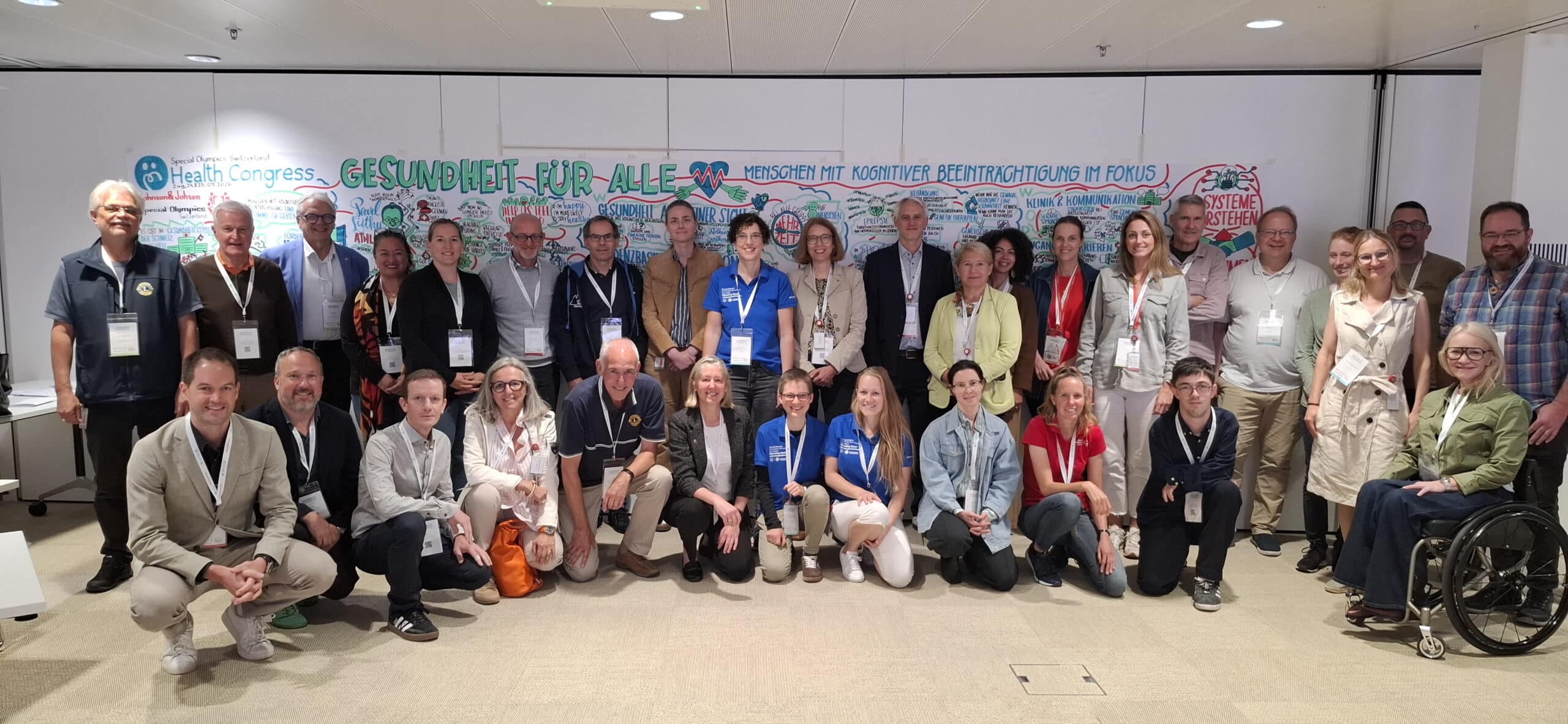
Zug, October 27, 2026 – People with intellectual disabilities still face barriers in the Swiss healthcare system. At the first Health Congress of Special Olympics Switzerland in Zug, people with intellectual disabilities discussed concrete solutions together with professionals from medicine, institutions, politics, and authorities, as well as national and international experts. The central message: inclusive healthcare must be structurally anchored.
Under the motto “Health for all – focusing on people with intellectual disabilities. Understanding systems. Strengthening cooperation. Shaping health.”, the focus over two days was not only on existing challenges but on concrete solution approaches.
People with intellectual disabilities have an increased risk of avoidable health problems and a higher mortality rate. At the same time, the Swiss healthcare system is not yet sufficiently geared toward their needs. “People with intellectual disabilities have the same right to high-quality healthcare as everyone else. This requires more knowledge among healthcare professionals, understandable communication, sufficient time for treatments, and structures that take different needs into account from the very beginning,” say Romain Fardel, Head of Health, and Dr. Martin Liesch, association doctor and board member of Special Olympics Switzerland. Both share responsibility for the further development of the Health project.
A central principle of the congress was “Nothing about us, without us”. Special Olympics athlete Pearl Lüthy shared her perspective in a panel together with medical and international experts.
Four workshops – four clear fields of action
The experiences of people with intellectual disabilities and their families were also at the center of the workshops. In addition, there was an in-depth look at where changes are necessary and how they can be implemented. This involved both the direct encounter between patients and healthcare professionals as well as structural improvements in the healthcare system.
Understandable communication and sufficient time
In the workshop “Health from my perspective”, the focus was on the perspective of people
with intellectual disabilities. The message was clear:
healthcare professionals should speak directly with those affected, ask clear
questions, and allow enough time for answers and examinations. A QR code on a
wristband was also discussed as a possible way to make important health
information accessible in an emergency.
Medical knowledge put into practice
The workshop “Evidence-based inclusion” explored how
medical knowledge can be better put into practice. Healthcare professionals
need practical recommendations, checklists and peer coaching to identify
diagnostic challenges earlier and to be able to examine and treat people with intellectual
disabilities appropriately.
Inclusive healthcare in education
In the workshop “Getting the system moving”, the focus was on the initial and
further training of healthcare professionals. In the coming years, sustainably
effective training and awareness-raising programmes
are to be developed together with
educational institutions, professional associations and healthcare facilities.
Healthcare must reach people where they are
The fourth workshop “Strengthening health systems through cross-sector
collaboration” addressed how gaps in care can be closed and
access barriers reduced. One possible approach discussed was mobile
and low-threshold healthcare units that bring services closer to
people with intellectual disabilities.
Inclusion needs appropriate framework conditions
The participation of representatives from politics and authorities also showed that inclusive healthcare is not the task of medicine and nursing
alone. Dr.
Rudolf Hauri, Cantonal Physician of the Canton of Zug, Andreas Lustenberger, President of the
Health Commission of the Zug Cantonal Council, and National Councilor Manuela
Weichelt shared their perspectives. Framework conditions are required,
that enable inclusive care: from initial and further training to
sufficient time for treatments and the reduction of administrative and communicative
barriers.
From exchange to concrete implementation
On the second day of the congress, inclusion became a practical experience. With Opening Eyes,
a service of the Special Olympics health program Healthy Athletes,
examinations were demonstrated with people with intellectual disabilities from
Züriwerk. This made it immediately visible how health services can be designed according to needs and how professionals can simultaneously be
sensitized to inclusive care.
During the subsequent speed networking, participants worked on the
future of Healthy Athletes Switzerland. The focus was on the five areas: Strong
Minds for mental health, Fit Feet for foot health, Special Smiles for
dental health, Healthy Hearing for hearing health, and Opening Eyes for
vision health. For its sustainable expansion, Special Olympics
Switzerland is looking for partnerships with professionals, universities, companies,
foundations, and professional societies.
From congress to action
After two intensive days, it is clear: the challenges and possible solutions
are known. Now it is a matter of turning the exchange into concrete cooperation and
projects.
With a view to the Special Olympics World Winter Games 2029, Healthy Athletes Switzerland is to be sustainably expanded and more closely networked with the Swiss healthcare and education system. However, the goal goes far beyond 2029: people with intellectual disabilities throughout Switzerland should have access to healthcare that is understandable, accessible, and geared toward their needs.